ServicesGutters
Gutters in Guthrie, OK
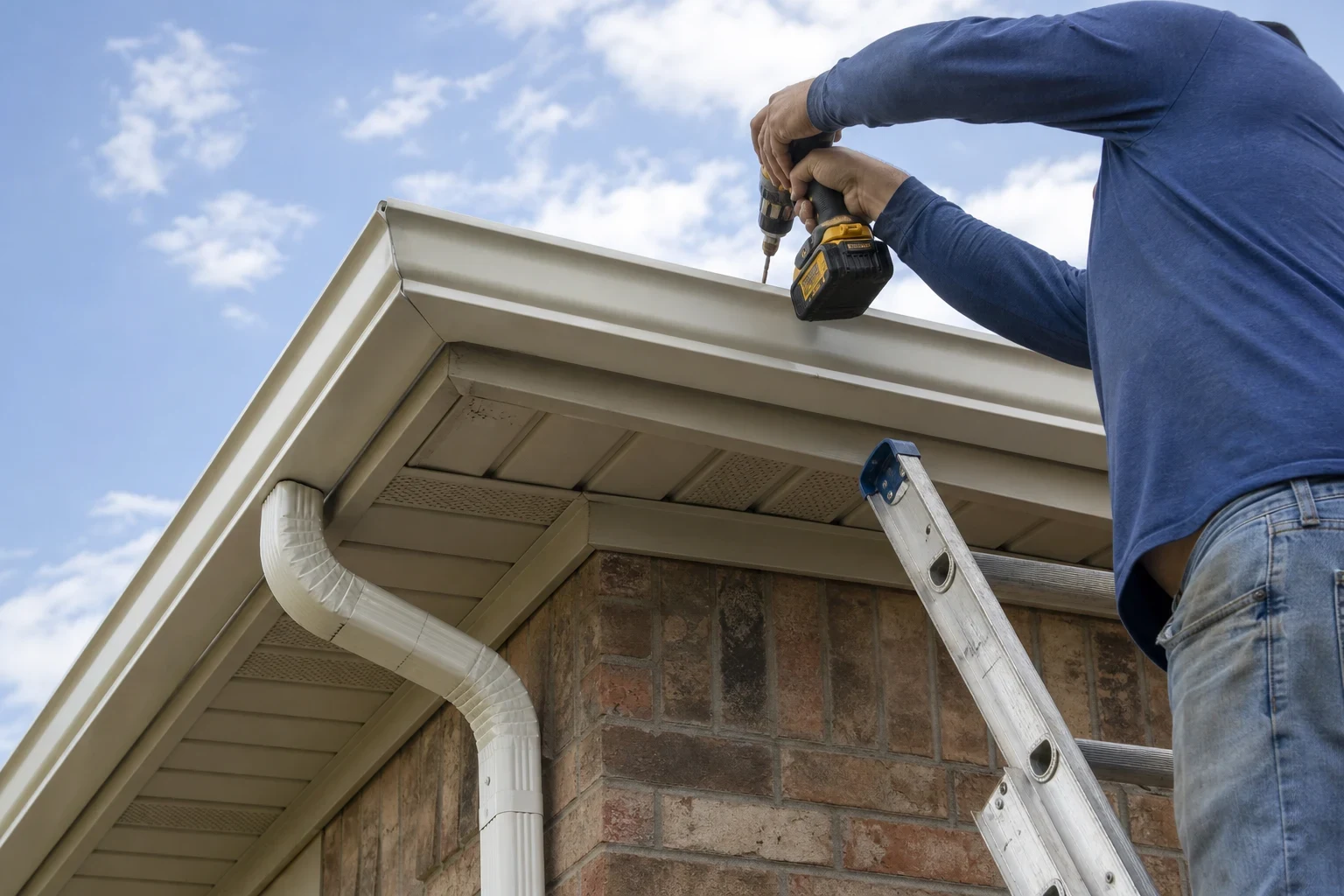
We install and repair gutters that are sized for the rain we actually get, pitched so water keeps moving, and fastened to sound fascia. Your roof stays dry at the edges, and the water ends up away from your foundation instead of beside it.
Gutters are the last step of your roof's drainage
A roof sheds water, but the gutters decide where it goes next. When they sag, clog or come loose, that water spills over the edge, soaks the fascia, stains siding and pools against the foundation. Spring storms here can drop a lot of rain in a short time, so a gutter that is too small or pitched the wrong way shows its weakness fast.
We handle gutters as roofers, not as an add-on. That means we look at the drip edge, the shingles at the eave and the boards the gutter hangs from before we hang anything. Our team holds an Oklahoma residential roofing license and an Oklahoma general contractor license, so the roof edge and the gutter are treated as one system.
Gutter work on its own usually doesn't need a building permit. When it's part of a roof replacement, it falls under that job's permit and inspection, and we tell you plainly which case applies to your home before work starts.
What our gutter work includes
Sizing for real rainfall
We look at roof area, pitch and how many slopes feed each run, then choose gutter width and downspout size to match. A long back slope often needs a larger gutter or an extra downspout.
Correct pitch
Each run should drop gently toward its downspout. Set it level and standing water holds leaves and grit against the seams; drop it too sharply and heavy rain races past the corner and over the end.
Fascia and drip edge check
Hangers only hold as well as the wood behind them. If fascia is soft or the drip edge is missing, we show you photos and explain the fix before installing.
Downspouts aimed away from the house
We plan where each downspout empties and fit an extension or splash block where it's needed. That way runoff spreads across the yard instead of collecting in a bed right beside the wall.
Repairs and re-hanging
Leaking seams, loose hangers, crushed sections and bent downspouts can often be fixed without replacing the whole system.
Signs your gutters need attention
Water pouring over the edge
If rain spills over the front during a normal storm, the gutter is clogged, undersized or pitched wrong.
Sagging or pulling away
A gutter that dips or gaps from the house usually has failed hangers or rotting fascia behind it.
Peeling paint and stained siding
Streaks below the gutter line and paint flaking off the fascia point to steady overflow or leaking seams.
Puddles or erosion at the foundation
Washed-out mulch, trenches in the soil or a damp crawl space often trace back to a short or disconnected downspout.
Dents after hail
Hail can crush gutters and downspouts enough to slow drainage even when the damage looks cosmetic. If the roof was hit too, our storm damage repair page explains what we check.
How a gutter job goes
- 1
Start with a phone call
Describe the overflow, sagging or leak you've noticed, and we'll pick a time to see the gutters and roof edge in person.
- 2
Look and measure
We check the fascia, drip edge, pitch and every downspout, take photos, and give you a written estimate with each item listed. If a repair will do, we say so.
- 3
Install day
We protect plantings and walkways, remove old gutters if needed, repair any damaged boards, then hang and pitch the new runs. Most homes are done in a day.
- 4
Flow check and cleanup
Before we pack up, we pour water into the high end of each run and watch it reach the downspout and drain out. Then we haul off the old gutters, stray fasteners and scraps so your yard is left tidy.
What affects the cost of gutters
No two homes have the same rooflines, so our number comes from measuring yours, not from a guess. The written estimate breaks the job into separate lines, so nothing is bundled out of sight. Here is what tends to raise or lower the total.
- Length and stories
- Total linear feet and the height of the eaves drive labor and material. Two-story runs take more setup and care.
- Gutter size and material
- Larger gutters and heavier-gauge material cost more but handle big rainfalls better.
- Soft or rotted fascia
- New gutters can't hang on wood that's breaking down, so damaged boards get swapped out first. You'll see photos of what we found, so that extra line on the estimate makes sense.
- Downspouts and drainage
- More downspouts, longer extensions or tricky corners add parts and time.
Gutter questions we hear
Something not covered here? (405) 883-9361
Do I need a permit to replace my gutters?
Usually not when gutters are replaced on their own. If the work is part of a roof replacement, it's covered under that permit and inspection. We'll confirm what applies to your home before we start so there are no surprises.
Can you repair my gutters instead of replacing them?
Often, yes. Leaking seams, loose hangers and a bent downspout are common repairs. If the gutters are badly rusted, undersized or sagging along most of the run, we'll explain why replacement makes more sense.
I'm planning a new roof. Do the gutters go up first or last?
Plan the two together. The drip edge and the shingles at the eave sit right where the gutter hangs, so gutters installed first often have to come down again when the roof goes on. We usually hang new gutters at the end of a roof replacement, once the eave is finished.
Will gutter guards stop all the cleaning?
They cut down on leaves and twigs, but they don't make gutters maintenance-free. Fine debris and shingle grit still collect, so an occasional check is still a good idea.
Which towns besides Guthrie do you cover?
We take gutter jobs across the surrounding area, including Edmond, Piedmont and Stillwater. The Service Areas page has the full list. If you're not sure your street is in range, just ask when you call.

Let's get the water moving the right way
Tell us what you're seeing at the roof edge. We'll set up a visit, measure everything and walk you through a written estimate.